
Budo Isn't Finished
It's still growing

A lot of people imagine Japanese budo as a finished product. They think of it as the handed- down wisdom of old, dead guys, and that the only thing to do is preserve what they left us; that the old masters were geniuses living in unique ages of hand-to-hand combat that can never be equaled. Even the founders of recent styles such as Kodokan Judo and Goju Ryu karate are idealized as people whose skill level we can strive towards, but will never be surpassed.
Koryu and gendai budo aren’t static. Judo keeps changing and growing. People are constantly testing it and looking for ways to apply the principles that Kano Jigoro Shihan elucidated more effectively. Koryu aren’t finished and complete. Judo is not in its final form. Karate hasn’t stopped growing. No real budo is ever finished developing, growing, and changing. The old masters knew a lot, but no one knows everything. There is always something to learn, some incremental improvement that can be made. That’s one reason the older budo are 古流 koryu (old streams) and not 古石 koseki (old stones). They can change and adapt and grow new parts and lose old ones.

Budo systems are constantly changing and adapting. Sometimes they grow by developing new techniques or new applications. Sometimes they shrink by pruning things that are discovered to have weaknesses, or that no longer seem appropriate. Many koryu ryuha have stories of weapons that were once taught but whose lessons have been lost for some reason, good or bad. Modern budo systems add and subtract things all the time. Did you know that Kodokan Judo once had a weapons section that taught jo and naginata? It was abandoned after World War 2 in the effort to convince the Allies that judo was not a threat to anyone. It did exist though. And it could be revived if interest developed among judoka. Judo also added a major kata, the Kodokan Goshijutsu forms, in 1956.
In addition, there is no reason koryu budo systems should be frozen in the form they had on January 3rd,1868 when the Shogun relinquished power to the Emperor’s supporters. Nothing makes that moment in the history of combative systems special. Shinto Muso Ryu, one of the systems I’m most familiar with, has added weapons and kata to its curriculum since then.

Koryu budo absolutely have to keep engaging with the world around them to remain anything more than museum pieces for historical reenactors. This engagement can be anything. If you’re doing an iai system, that engagement may be invisible to most people. When I was an account manager dealing with -Toyota, GM, Honda, Chrysler (or whatever name they had at that moment), and Nissan, I used iaido in every meeting. No, I didn’t draw a sword and take the head off the guy across from me that I could sense was a threat (no matter how much I wanted to).
However, everything from my posture to my breathing to my mental state as I was negotiating contracts worth tens of millions of dollars could be traced to my iai and jo. I knew how to maintain a dominant body posture even when I was being attacked verbally and financially. My practice controlling my breathing and maintaining a calm, focused front in iai was critical to dealing with rampaging social bullies who liked to pound the table and yell during meetings because they thought they were being intimidating. It’s remarkable how quickly the table pounders settled down once their tactics were met with looks of boredom.
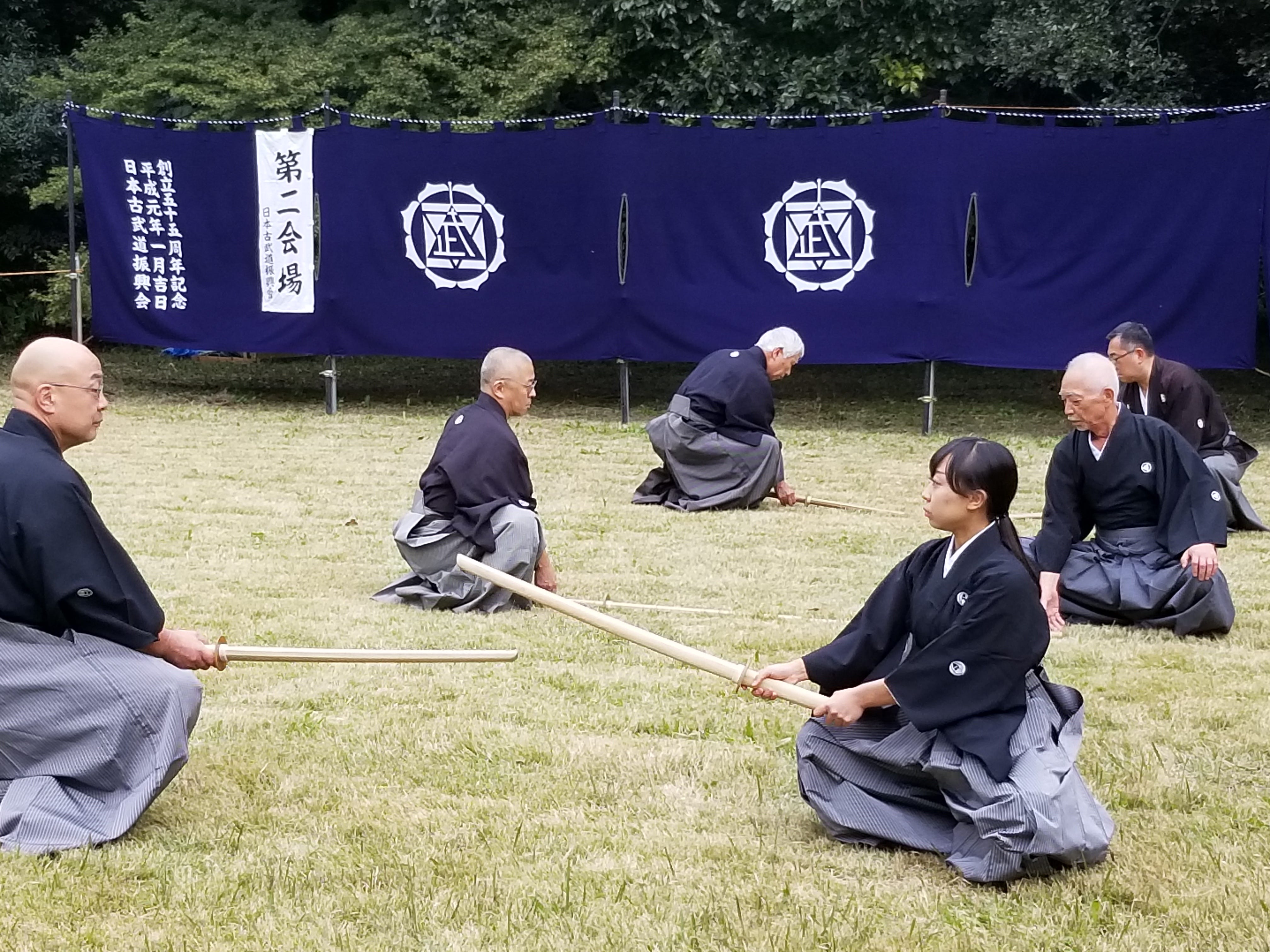
If the art is a sogo budo such as Shinto Muso Ryu or Takenouchi Ryu, perhaps that engagement is more direct. There is nothing stopping the leader of the ryuha from adding to it. Shinto Muso Ryu famously added a new weapon to its curriculum in the late 19th century, the walking stick. And in the mid-twentieth century, one branch of the ryuha added an entire new set of kata to add depth to aspects of the training.
Modern policing took the jutte 十手 of Shinto Muso Ryu fuzokuryu Ikkaku Ryu, added modern technology, and created the telescoping police batton. It’s easy to imagine a Shinto Muso Ryu menkyo kaiden, or the head of another sogo budo, adding to their curriculum by applying the ryuha’s principles to some new aspect of technology. It would take something exceptional to warrant this, but it’s certainly imaginable. Shinto Muso Ryu has a relatively limited curriculum, with only the jo, tachi, kodachi, jutte, walking stick, kusarigama, and hojojutsu (binding with a rope) covered. I can certainly see someone formalizing some of the kuden (verbal teachings) into jujutsu kata, or adding other weapons that are deemed important in the future.
Arts like Takenouchi Ryu and Kashima Shinryu already have huge curriculums that encompass many, many weapons. I find it hard to imagine there being any new hand-to-hand technique or weapon that they don’t already have in the teachings that can be directly applied to current practices. It’s possible that my imagination just isn’t good enough to come up with something they don’t already have covered. The Kodokan might someday decide to revive their weapons section so students develop a truer understanding of the power and limitations of some fundamental weapons.
Budo, even koryu budo, aren’t finished. They have to be able to adapt to the world. It’s ironic that one of the least practiced kata in the Kodokan curriculum is quickly becoming relevant outside the dojo again. In Japan, it’s been more than 150 years since samurai regularly wore armor. In the west no one wore armor for hundreds of years. Now though, armor is back in a big way. Police and soldiers all wear plenty of armor. Armor changes critical parts of a combative interaction. Useful targets are limited. The number of effective throws and grappling techniques is reduced. The Koshiki No Kata is all about dealing with an attacker wearing armor, though normally it’s practiced without armor. However, with the proliferation of armor again, it makes sense to practice it wearing armor. Judo isn’t the only budo with teachings for armor. Arts such as Yagyu Shingan Ryu and Takenouchi Ryu, which still teach how to move and fight in armor. are suddenly very relevant. Not because they changed, but because they didn’t. They didn’t stop practicing the armored aspects of their arts. They saw the value of that knowledge and did not allow it to be lost. The wheel of history has come back around and armor is relevant again. So are ancient jujutsu systems.
Budo isn’t finished. It will never be complete as long as the world continues to change. New weapons. New situations. New armor. There will always be new things that must be adapted to new situations. Sometimes that will mean adding a new weapon or technique to a system. Sometimes it will mean dropping one because someone else developed an effective counter, transforming the technique into a liability. There are arts focused on sticks of varying lengths. Others focus on blades, while some focus on empty hand techniques. Some specialize in chain weapons. Koryu and gendai budo have techniques for everything the warriors that practiced them could imagine. The arts they created are not carved in stone. They are ryuha 流派, stream branches, and those streams are still flowing, still adapting to the landscape through which they run. They are alive, and the healthiest ones will continue to adapt their principles to meet the changing world in which they exist.
Special thanks to Deborah Klens-Bigman for editorial support.
