
Do Koryu Keep Inefficient Techniques?

Reader Ray wrote: I would be interested in your opinion about the following: koryu school are keeping their traditions even if some of the techniques have physical inconsistency.
The efficacy and use of some techniques in various koryu have been questioned since at least the Meiji Era. Koryu are by definition “old schools.” Two or three hundred years from the founding, how can you be sure the techniques are still effective? How can you be sure they are consistent with what was originally taught? Have things been lost or changed to the point that they are no longer consistent?
My experience is that in well-maintained koryu, the techniques will be consistent, effective, and efficient. If they aren’t all three, then either something is being taught incorrectly, or the student doesn’t understand it well enough yet. I do see koryu that teach things poorly, especially in koryu that have become essentially fossils. These are koryu where the skeleton of the technique and kata have been preserved, but the knowledge that animates them has been lost, so people simply repeat motions without understanding them. There are a few of these around, and if you watch carefully, you can spot some of them at big koryu enbu like the one at Meiji Jingu every year.
Even in well-preserved, well-cared for koryu, things can get lost. Ellis Amdur of Kogen Budo has written extensively about reconstituting bojutsu of Tenshin Buko Ryu. They still had documents, but the practice had been lost. Koryu are living arts, and things are lost and added and rediscovered all the time. Not every teacher is a good teacher, so sometimes the transmission is weak. These things happen. In living koryu, as opposed to fossilized koryu, this isn’t an overwhelming problem. Senior teachers and practitioners should always be testing their understanding, challenging themselves and the art to be sure both are at their best.
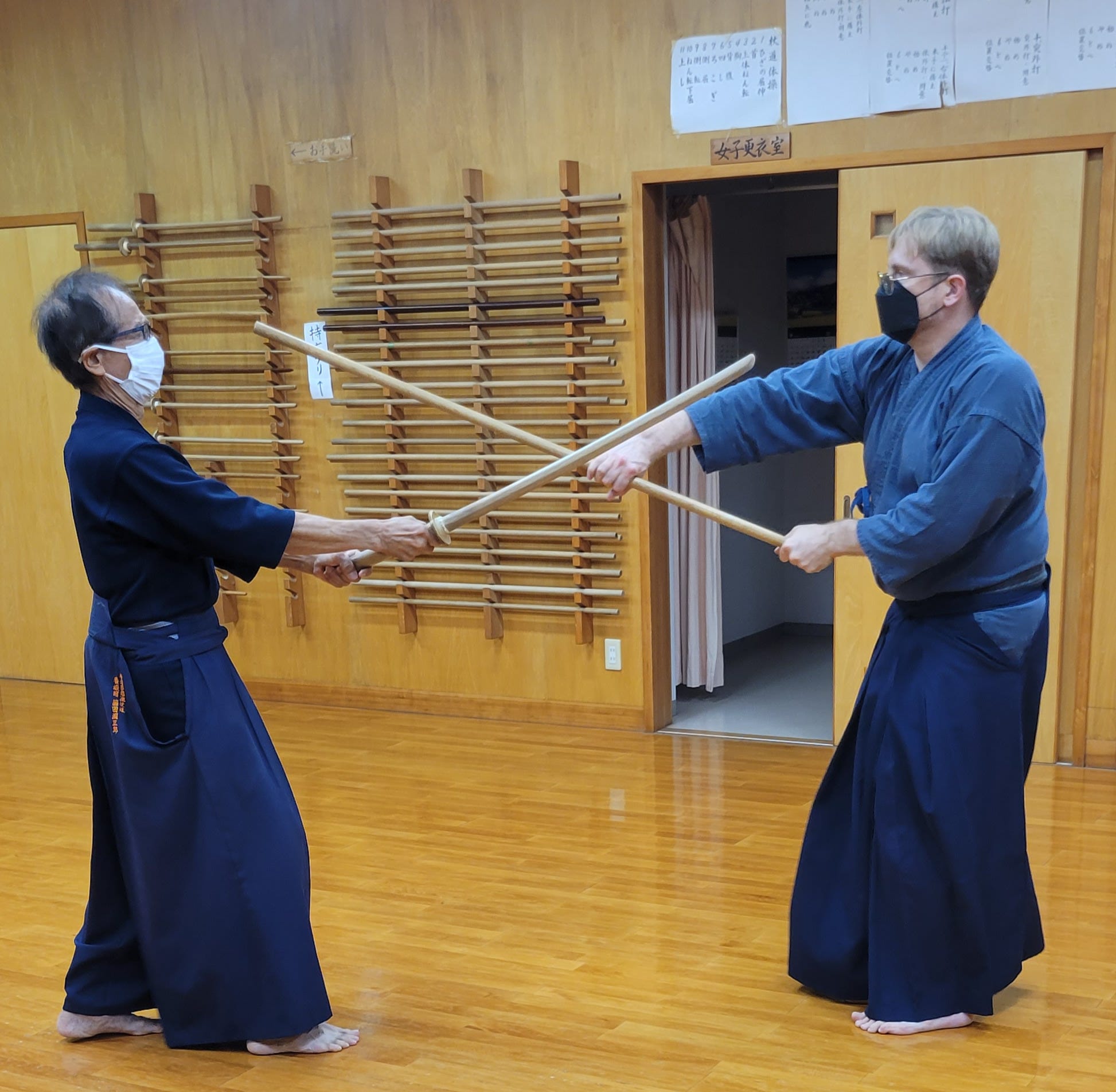
Gendai budo practitioners often make the mistake of thinking that because koryu don’t have competitive sparring, there is no pressure testing. They couldn’t be more wrong. Anytime you have a two-person koryu kata, you have the potential for pressure testing. Ideally, each kata represents the optimal way of doing something. If you do everything correctly, the kata works. If your training partners are being honest, they will follow the logic of the kata, and attack where the best opening is. If the best opening they see is one you’ve left that shouldn’t be there, that’s where they will attack. This can make for an unpleasant surprise anytime you don’t do things well. A whack on the kote or do or men when you aren’t expecting it is one of the best ways of learning to close those suki (openings). I’ve collected plenty of small bruises because I left suki that shouldn’t be there.
This is pressure testing. Your partner isn’t breaking the kata when they attack into a suki that you left. You broke the kata when you created the suki. Your partner is following the logic of the kata and attacking the best target. It’s always possible that someone sees an opening that’s not part of the kata. The proper response to this is to talk with your teacher, and arrange to try attacking the opening so it can be tested. I’ve seen many “openings” in kata that I was learning, and I’ve discovered the hard way each time that they aren’t really openings. I just didn’t know enough yet to understand why that attack was a bad idea. Teachers of living koryu aren’t afraid of exploring and experimenting. Before you try something though, it’s useful to remember that the arts you are experimenting with are hundreds of years old, and whatever you think you’re seeing has likely been thoroughly explored during the previous centuries.
Another common issue for students is that they just don’t know enough to understand what they are looking at. This has happened to me often enough that I’m very hesitant about pointing out what seem like weaknesses to me. A friend with a long memory likes to remind me of the times I told him “You can’t do that.” He then would proceed to prove to me that he can. I’m still learning things. My teachers are still learning about the ryuha they practice and teach. Receiving a menkyo kaiden means you have the full transmission, but it doesn’t mean you have total understanding. There is always more to learn from the kata. I was working with a menkyo kaiden holder recently, and we ran into something he found interesting and started exploring. I’m looking forward to seeing what his explorations reveal. There is always something more.
Sometimes you’ve been given the lesson and not understood it. I was excited last year because I worked out something that seemed to be a real step up on one of my techniques. Then I was training with one of my teachers. As we worked through his lesson, I realized that he had already addressed my “realization” from a different angle, and I hadn’t understood it. These lessons always make me wonder what else I’ve been taught that I still don’t understand. Sometimes the only inefficient thing is the pace of our understanding.
Koryu are not meant to be understood clearly from the beginning. The teaching can be subtle and require multiple steps before you fully understand it. Shinto Muso Ryu jodo has dozens of kata grouped in sets. As students learn each set, they are exposed to new ideas, skills, and ways of thinking. Once they have learned a set well, they move on to the next set, which will teach new things that will transform the students’ understanding of previously learned kata. This process repeats over and over throughout the curriculum. Over time, movements that were strange, impenetrable, and inefficient, become familiar, clear, and effective.
Of course, this assumes that the koryu is healthy and has been transmitted effectively. Sadly, this is not always the case. Many koryu have lost their deeper teachings through disinterest or poor teachers. These fossilized koryu preserve the skeleton of the kata but not the spirit that should animate it. Another, modern problem, is that there are a lot of people teaching who really aren’t ready yet. They learn a little in Japan, go back to their home country, and start teaching. In Japan they weren’t even senior students, much less shihan. Because of the distance though, they are able to gather students and begin teaching. Lacking sufficient depth of knowledge and experience, what they are teaching is fundamentally flawed. In those cases, it is not uncommon to see people do things that are inefficient and not in line with the principles of the ryuha.

Inefficient techniques can appear even in healthy, well maintained koryu. The difference between healthy koryu and unhealthy koryu is that the teachers and senior students of the healthy ones will be testing their technique in the dojo and weeding out techniques that aren’t 100% effective. Ellis Amdur writes about this extensively in his new book, Roots Still Cracking Rock. Fossil koryu seniors don’t push the kata and don’t question anything. They just keep doing the same things over and over, preserving the form while the spirit dies.
If you think you are seeing truly inefficient and incongruous techniques in a koryu, look at the way the kata are being executed. Are they lively? Are the practitioners making genuine effort to get to each other with their techniques? Do they attack each other with spirit and vigor? Are the practitioners displaying skill and control? If the answer to any of these is “no” then it may not be a problem with the technique, but with the people doing the demonstration. They may know the choreography of the kata without knowing the logic and reasoning of it. If so, they either lack true understanding of what they are doing or they are displaying a fossil, not a koryu. Real koryu are alive, changing, growing, and adapting even while we watch. Senior teachers and practitioners of true, living koryu should always be pushing, testing and debating techniques in order to keep it alive.
Special thanks to Deborah Klens-Bigman for editorial support.
My goal is to keep this blog free and accessible to everyone. If you find it of value, please consider supporting it’s continued publication by buying me a coffee so I have the energy (and excuse to give my wife) to keep learning and writing.

Another fantastic article Peter.
The only thing I'd add is that when you're training for any athletic pursuit, you do things that build up your physical capacity which aren't directly "doing the thing". No reason Koryu kata should be any different.
Baseball pitchers run laps around the field like everyone else, even though they aren't moving any further than first base most of the time. In the same sense, maybe that kata a skeptic is scratching their head at is about training your reaction time, your sense of distance, or it's just leg day...